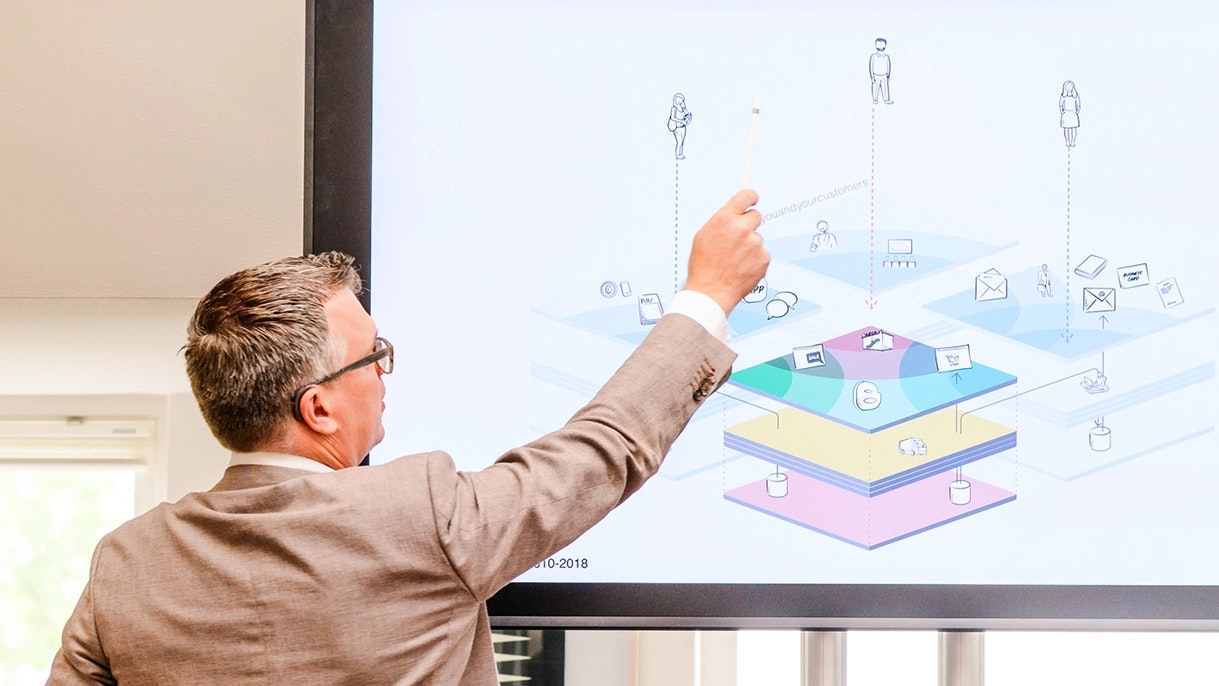
Service Blueprints Made Simple: From Spaghetti to Lasagne with the Exploded View


In this article, Author Marco Torrente at foryouandyourcustomers explains how to turn research insights into a clear blueprint using Exploded View as our methodology and turn them into a service blueprint. The model helps set clear swimlanes, make frontstage and backstage work visible, and move from a customer journey to a shared blueprint skeleton—covering roles, processes, systems, and data.
Downloads
A service blueprint helps clients see how the customer experience connects to the organisation. It supports an outside-in view, shows how value is delivered, and makes the behind-the-scenes work visible.
Once customer research is done it helps to use a visual framework such as a service blueprint to highlight friction points and identify how a service is delivered to customers.
But creating one from scratch can feel overwhelming, especially when choosing the right structure for the swimlanes for your context. To get started there are a lot of templates available, such as those on Miro, that offer various ways to organize a service blueprint. But creating a service blueprint from scratch can be surprisingly slow, especially when you get stuck on one question: What swimlanes should we use?
A proven approach of creating a service blueprint is to make use of the layers of the Exploded View framework:
A CX Framework for Modern-Day Da Vincis
Leonardo da Vinci was a fabulous artist! And I believe our work in customer experience can improve by learning from him.
The way Da Vinci turned complex insights into captivating drawings inspires me to always chase on point visualisations to reduce complexity and show context. It starts with a clear and holistic view on the end result and trickles down to bringing all the various pieces of the puzzle into harmony.
Sounds easy? Well, a complicating factor is the fact that we typically work in teams. Where Leo could determine his own views, CX teams need a shared understanding of what to focus on and which puzzle pieces fit together.
Tough? Yes. But it is also possible. I always use the holistic framework that Jonathan Möller invented: The Exploded View.
The Exploded View is both simple and comprehensible – just like Da Vinci’s work – and enabling smooth cooperation within teams. It recognises both the larger contexts and applies several perspectives - like Da Vinci’s drawings. And it invites everyone to feel - and actually be - involved.
What is the Exploded View?
The Exploded View model can be used in many ways within a company and serves as a guide for the employees involved in a (digital) project enabling efficient collaboration and a deeper understanding of the relationships between the company and its customers.
Due to its spatial nature the Exploded View helps to map the customer and the organisational perspective across six layers. This allows everyone in a team to identify the impact, challenges or ideas on a single layer while also seeing them in context across the different layers. As a result it becomes much easier to understand their implications on the other layers.
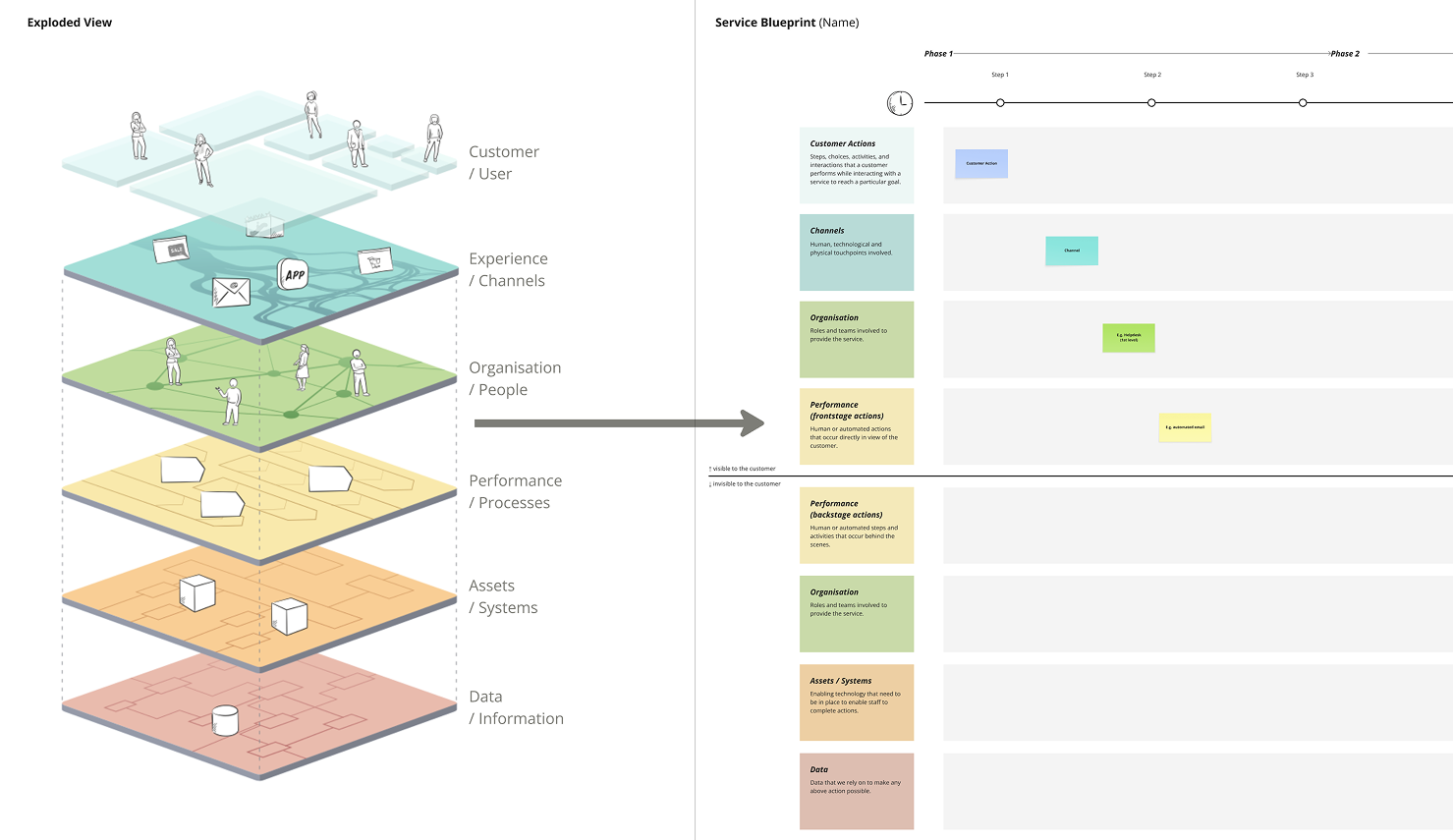
The structured, layered visualisation of the Exploded View with its holistic structure can be applied in most digital project settings, which makes it ideal for using it as a service blueprint. Interestingly, the Exploded View can serve as a basis for the swimlanes, introducing a vertical order that aligns with the typical structure of a service blueprint:
What happens frontstage (customers, experience)
What happens backstage (organisation, performance, systems, data)
Exploded View to Service Blueprint


Applying it hands-on: a layered approach with the help of the Exploded View
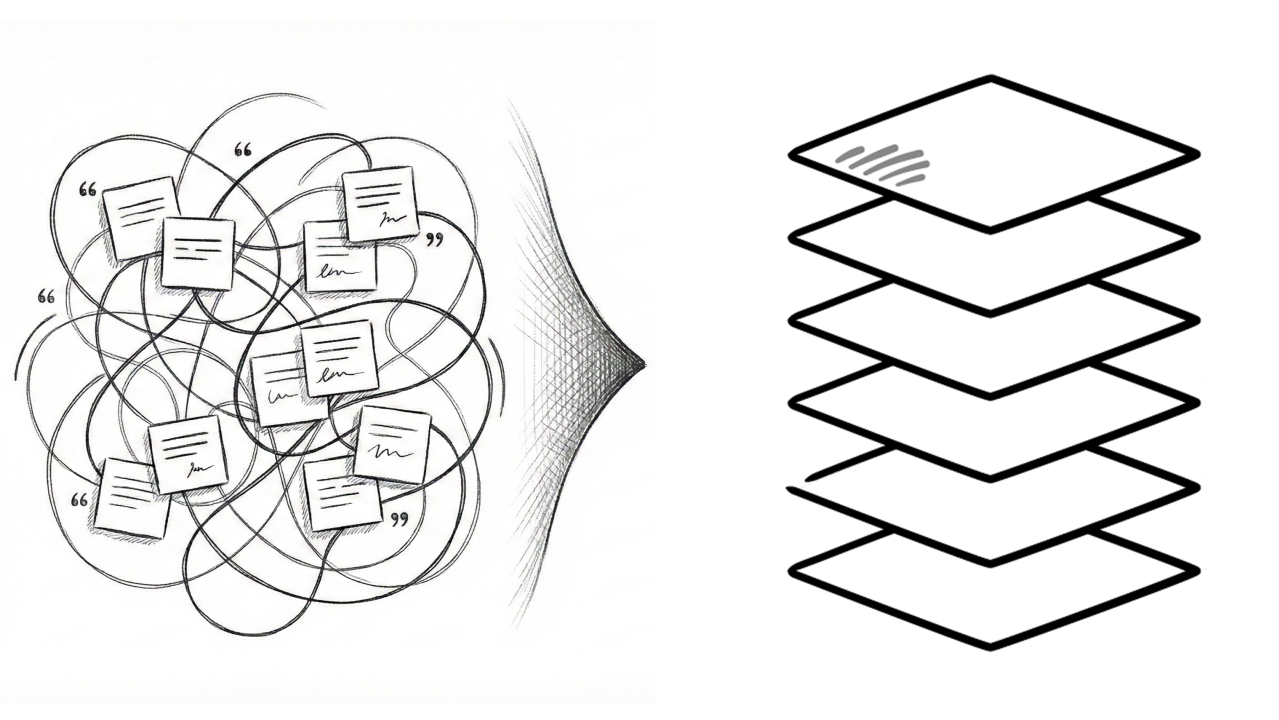
During the customer research it can feel like sitting in front of a plate of spaghetti: messi disorganised quotes which need organisation. During the thematic analysis I aim to structure relevant themes according to when they happen in time. This is the first initial representation of a customer journey. And it’s an exciting moment as the customer journey finally comes to life!
In a recent project, once research and insights were complete, I built the customer journey by laying out the phases horizontally and the layers vertically. For example:
Customer actions: steps or activities
Channels: Human or physical touchpoints
Organisation (roles and teams involved to provide the service)
Performance (front stage actions such as human or automated ones)
Because the swimlanes were already defined, I could draft a solid first version fast, without getting stuck on structure.
That’s when the spaghetti starts to become lasagne: the same ingredients, now in clear layers.
With the customer journey now complete, the next crucial step is developing the service blueprint. This is where the team's collective knowledge and expertise become essential.
Aligning teams on how they can deliver a service
Once the customer journey felt complete, it was time to get the entire team involved. They hold deep domain knowledge, have the right intuition and know their processes in and out. They have expertise on data, systems, processes and how they work together with other teams.
That’s why I find it super helpful to get the project team involved in a workshop to create all of the backstage items (organisation, performance, systems and data) together making the service blueprint complete. I usually share the customer research results as well as the customer journey that resulted after it. But a journey is never enough because the experience needs to be delivered from the organisation effectively. And adding backstage elements gives more clues in identifying why customers might experience friction.
In one case, I created a high-level “to be” journey after extensive research. In the workshop, we used the Exploded View layers to map the backstage side. That workshop output then became the basis for completing the blueprint digitally.
In just 90 minutes we went from a journey draft to a shared blueprint skeleton with the main backstage elements and a first visual representation how the improved service will work.
Ready to layer your insights? Download the “Spaghetti to Lasagne Cheat Sheet” as pdf to get you started or get in touch with me.



Dive deep into our Expertise
Related Articles