What does AI know about your business?


AI assistants now introduce your company to buyers before your sales team does. What they say is built from what your website tells them.
A lesson from newspapers
In 2009, the Polish newspaper designer Jacek Utko gave a TED talk with a blunt title: Can design save newspapers? Print was losing its readers to the internet. Utko's answer was not a prettier page.
He sat down with the papers' executives and tied each design to the paper's business goals. Design stopped being the last step before print and became part of how the news was told. TED credits his redesigns with circulation gains of up to 100%.
Your company is at a similar moment. A new reader has arrived, and it reads differently from the ones you designed for. That reader is AI.
Ask an AI about your company
Open an AI assistant and ask: What does our company do? Who are our experts? Which customers do we work with? The answer is often thin: a product line you retired is still there, your strongest capability is missing, your best-known expert doesn't appear.
The AI didn't make this up. It built the answer from what you publish, above all your website. It skips the design and the tagline and looks for entities, the things your business is made of (products, services, people, locations, customers), and the links between them. What your pages state as structured data, a short summary in each page's code that tells machines plainly "this is a service, this person works here, this case study is about that customer", is read reliably. What is buried in text is read less reliably. What is missing gets guessed.
AI is only as reliable as the data it finds. That is true for your product data, and it is just as true for the story of your company.
See your business the way a machine does
You can't fix a message you can't see. So the first step is to read your website the way an AI does, and draw those entities and links as one map.
The map has two lenses:
What the site declares: the facts stated in that structured summary behind each page. This is the clearest signal you send, and the one machines trust most.
What the text says: the facts that only appear in the written content, which an AI has to interpret.
Put the two side by side and you see the gap between the message you send on purpose and the one you send by accident.
Newspaper editors check a page proof before anything goes to print. The map is your page proof: your business as its new reader will see it.
We started with ourselves
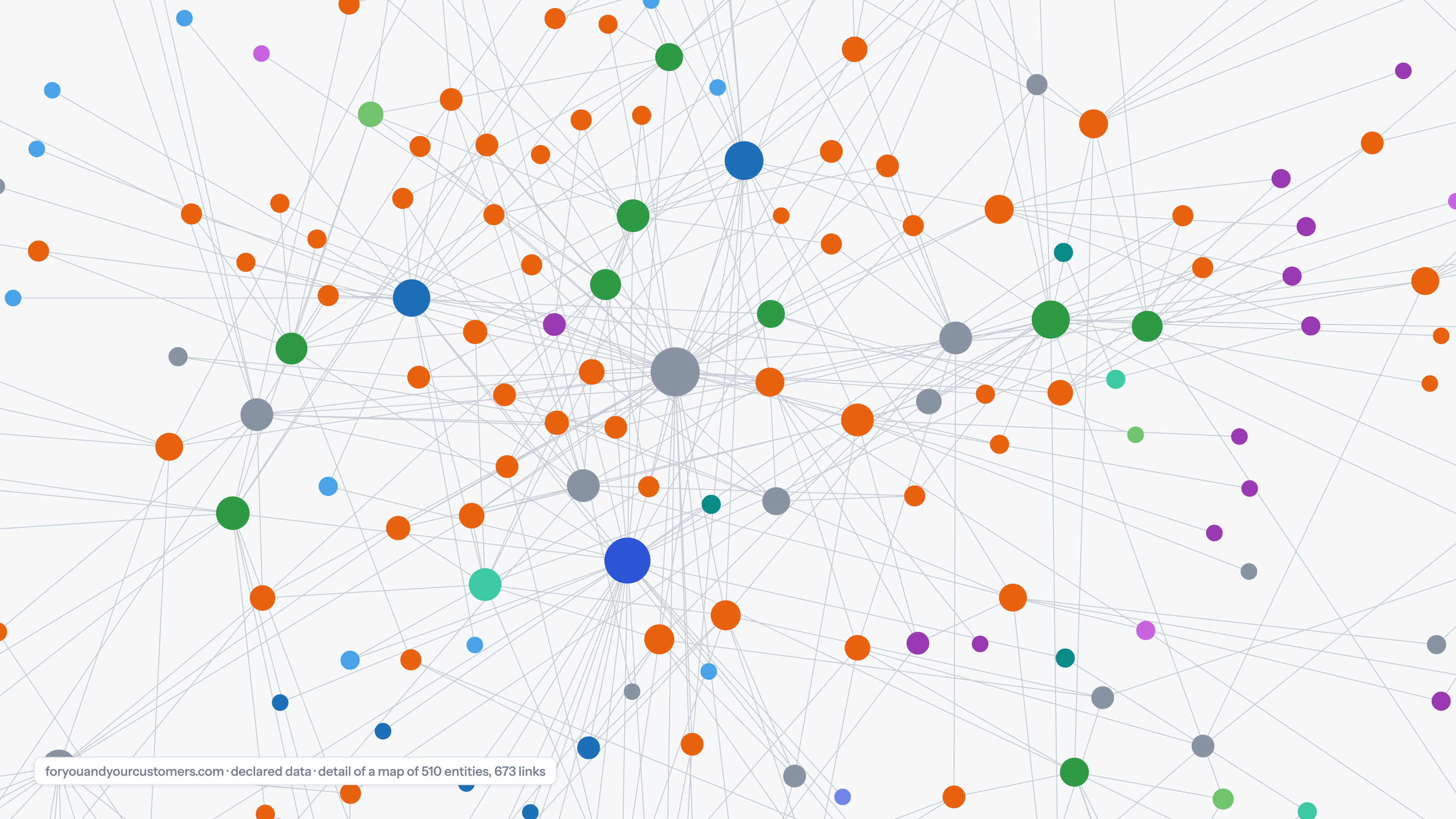
We wanted to know what AI actually learns about foryouandyourcustomers from our website, so we could shape that message on purpose. That's why we built Site Atlas. It reads every page and draws the facts the site declares as one map: 510 entities and 673 links across our 420 pages.
This is what we found:
133 of 133 people profiles are complete. Every expert can be found, with a role and a location.
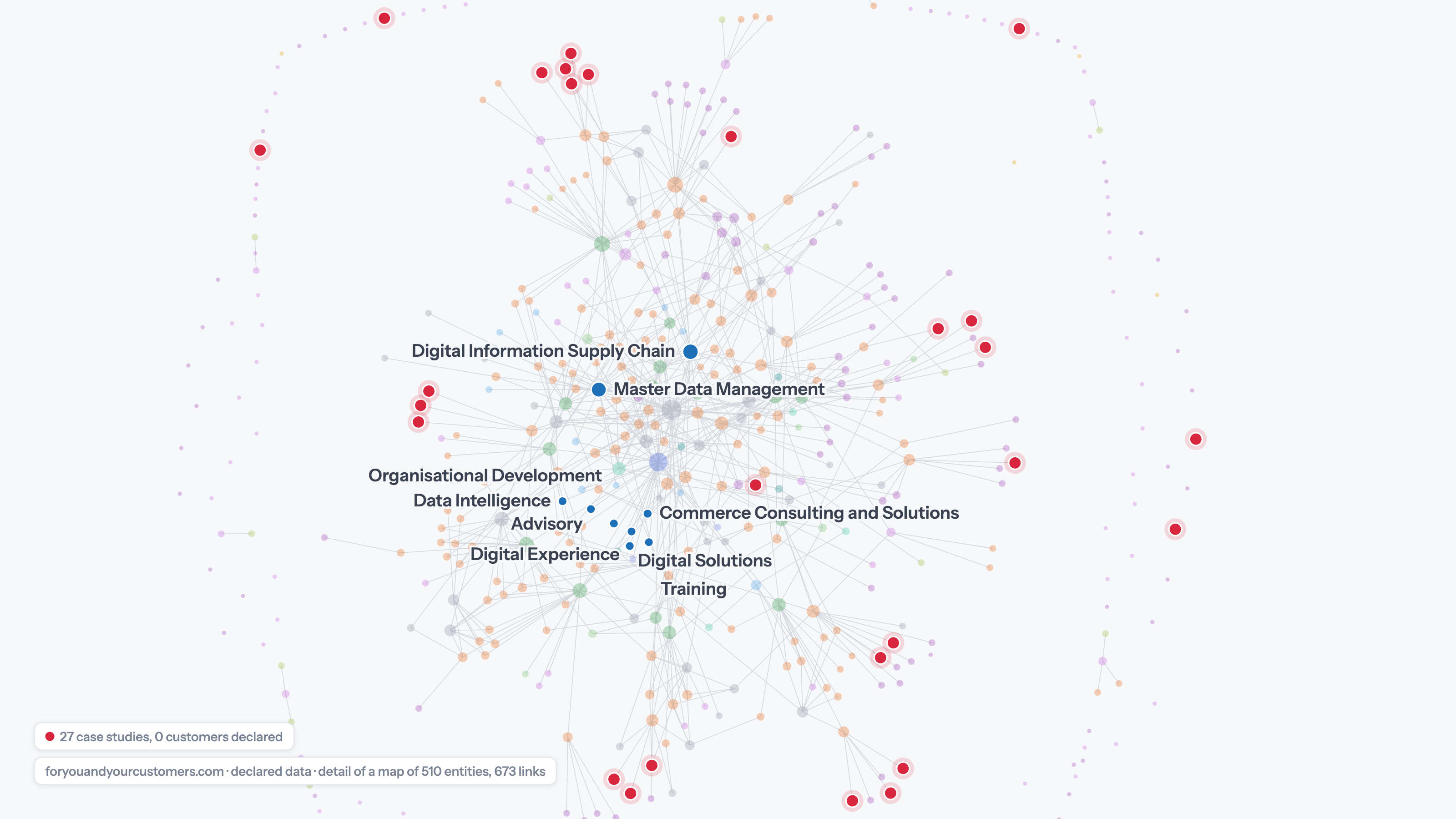
0 of 27 case studies declare a customer. Geberit, Fissler and others are named only in the text.
0 industries are declared. Nothing tells an AI which industries we serve.
1 of 138 articles declares what it is about.
1 of 12 services has the facts a buyer would ask about.
The case studies were the biggest surprise. They are our strongest proof, built on long relationships with real customers.
The website's own code tells AI about 510 entities and 673 links between them, but none of its 27 case studies says which customer it was for.


Five questions the map answers
The map is not a technical report. It answers five questions a leadership team should be asking anyway:
Does our website show the business we intend? Some offers are well-connected hubs. Others, sometimes the ones you're betting on, stand alone. To an AI, an isolated offer looks like a minor one.
What's missing? A product needs its category and use, an expert needs a role and a place. The map marks every point where those facts are missing.
Can a buyer's question be followed to the end? Buyers ask chains of questions: who makes this, who can advise me, for which customer have they done it before? Where a link between offer, expert, case study and customer is missing, the AI's answer stops, or it guesses.
Do we give the same entity different names? On large websites, one capability often ends up with three names. People cope with this. Machines split one strength into three weak ones.
What do we say but never declare? Valuable facts are often buried in text: a reference customer, a certification, a partnership. Our case studies are exactly this kind of asset, and the cheapest win: the substance is already there.
From diagnosis to a planned message
Seeing the map is the start. These are the five steps we use on our own website, and the ones we work through together with you.
Planning the message is a loop, not a one-off project: every round starts from a fresh map.


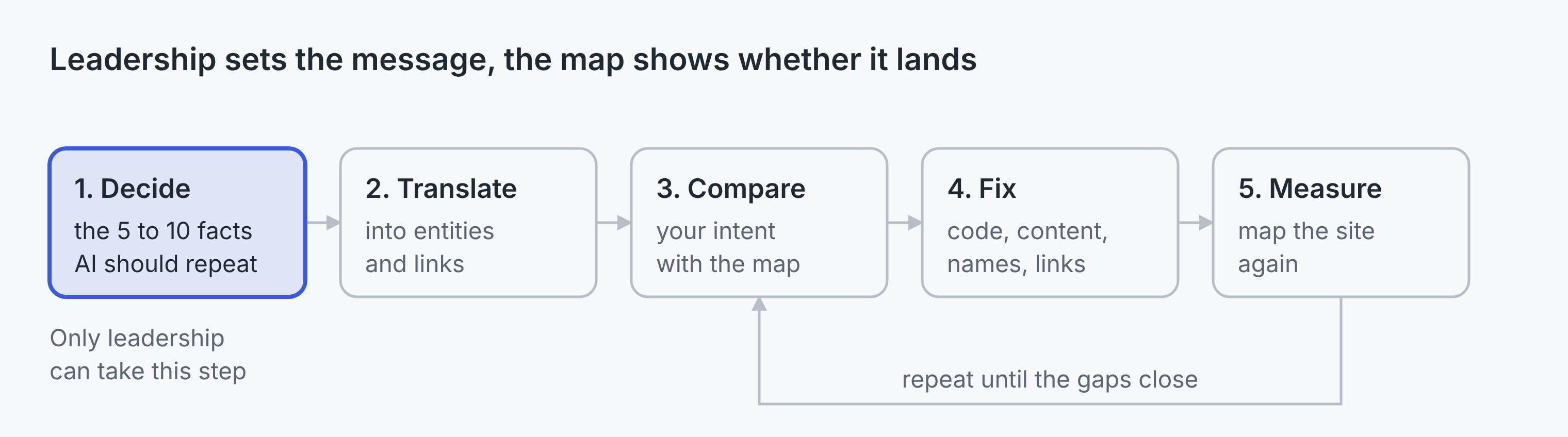
Decide. Agree, at leadership level, on the five to ten facts you want any AI to repeat about your company.
Translate. Turn each fact into entities and links: this service, led by these experts, proven for these customers.
Compare. Lay your intended message over the map. Which facts are weak, missing or contradicted?
Fix at the source. Structured data in the page templates, clearer content, links between related pages, and one name for each entity, used on every page.
Measure and repeat. Map the site again, and ask AI the same buyer questions to see how often you're named.
A clear message doesn't come from software alone. It comes from decisions, and the first step is the one only leadership can take. Developers can fix the code, and marketing the content. Only leadership can decide what the company wants to be known for. The same work pays off beyond AI: richer search results, and a sales team that can find the right expert and reference.
What a map can't do
It's worth being clear about the limits.
It shows what you publish, not what is true. If your website is wrong, the map is faithfully wrong. That is the point: it shows you what others see.
It only covers your own website. AI also reads partner directories, review sites and LinkedIn, and weighs your claims against them. Those sources need to tell the same story your site does.
Declaring facts is not a guarantee. No one controls exactly how an AI weighs its sources. Clear, consistent facts make a correct answer far more likely. They don't make it certain.
It doesn't replace a strategy. The map tells you where you stand. Deciding where you want to stand is still a leadership job.
A map is a mirror, not a megaphone. It won't make your message louder. It shows you whether the message is there at all.
Look before you tell
Most companies are sending AI a message they never planned, written by years of page edits and good intentions. You can't control what AI says about your company, but you can control what it reads. Ask an AI about your company this week, then look at what your website really tells it.
Utko asked whether design could save newspapers. The question for your business is whether your message survives its new reader.
Interested?
Let's talk about the message your website sends to AI. No obligation, and tailored to your situation.


