DPP Readiness Assessment: Is Your Company Prepared for the Digital Product Passport?


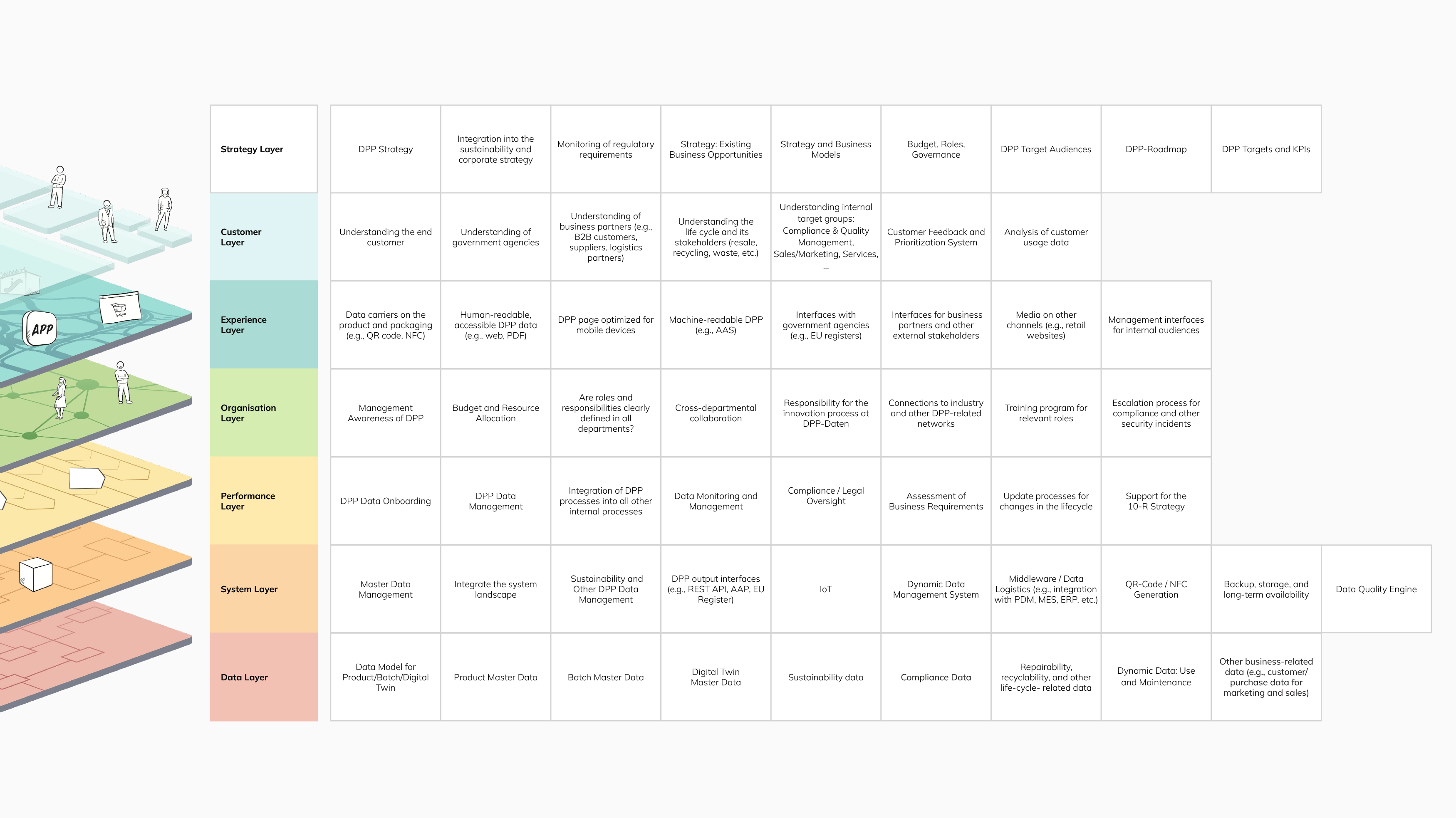
The clock is ticking: Starting in 2027, the Digital Product Passport (DPP) will be mandatory. However, many companies underestimate the complexity behind the small code. Those who see the DPP only as a compliance hurdle are missing opportunities. Those who view it as an isolated IT project will fail. Our DPP Readiness Assessment uses the proven "Exploded View" to holistically prepare your company for the circular economy.
The pressure on manufacturing companies is growing. The EU Ecodesign Regulation (ESPR) demands transparency across a product's entire life cycle. But where do you start when data is stuck in silos, responsibilities are unclear, and the IT landscape has grown historically? A pure software check falls short here.
Understand all layers of the Digital Product Passport with the exploded view
To make the Digital Product Passport (DPP) tangible, it makes sense to view it not as a pure data field, but as a layered model. Based on the Exploded View methodology, the complexity of the DPP can be divided into the crucial levels:
1. Strategy: The "Why" and the Roadmap
At this uppermost level, the DPP is defined as a strategic instrument. The goal is to harmonize the legal obligation (Compliance) with the company's objectives.
Business Case: Are we using the DPP only to fulfill EU requirements or as a basis for new, circular business models (e.g., Product-as-a-Service or Resale)?
Roadmap: When are which product groups affected (e.g., textiles 2027)? What priorities are we setting?
Positioning: How do we differentiate ourselves through transparency in the competition?
2. Customer & Experience: The Interface to the Outside World
This defines how the information reaches the user and what added value is created there. The DPP is a new, digital touchpoint.
Target Groups: Who needs which data? The end consumer wants information on origin; the recycler needs technical disassembly instructions; the authority demands compliance certificates.
Experience: How does the user access the passport? (QR code on the label, NFC chip, or digital twin in an app).
Trust & Brand: A well-designed DPP strengthens brand loyalty through demonstrable sustainability and transparency.
3. Organization & Processes: The Operative Gearbox
The DPP changes how departments work together. It is a cross-sectional topic that breaks down silos.
Responsibilities: Who is the "Owner" of the DPP data? Sustainability Management, Product Management, or IT?
Data Governance: How do we ensure that data from sub-suppliers flows into our systems in a timely, complete, and correct manner?
Change Management: Employees must be trained to integrate the new requirements of the circular economy (e.g., the 10-R strategies such as Repair or Recycle) into daily processes.
4. System & Data: The Technological Foundation
This is the technical "Engine Room" level. Without a clean IT architecture, the DPP remains a manual source of errors.
Single Source of Truth: Consolidating data in a central system (MDM/PIM like Stibo Systems) to avoid redundancies.
Data Model: Definition of the specific attributes (material shares, CO2 footprint, chemicals) required by the respective "Delegated Act" of the EU.
Interoperability: Building interfaces (APIs) to report the DPP to the central EU register and securely exchange data within the supply chain.
From Status Quo to Roadmap
The result of our DPP Readiness Assessment is not an abstract report, but a concrete recommendation for action. We determine your maturity level in every sub-discipline:
Quick Wins: Where can you gain immediate compliance certainty with minimal effort?
Strategic Gaps: Which structural changes are necessary to remain deliverable in 2027?
Innovation Potential: How can you use the collected data to develop new, circular business models?
Conclusion: Act Instead of React
The Digital Product Passport is the entry ticket to the European market of the future. Companies that do their homework today in data governance and system architecture will not only meet the legal requirements in 2027 but will enjoy a significant competitive advantage through transparency and digital excellence.
Contact Us
If you have any questions about the DPP Readiness Assessment, please contact us.